Services

Services

Eye Tissue Bank

Eye Tissue Bank

Diabetic Retinopathy

Diabetic retinopathy is currently one of the leading causes of blindness worldwide. Given the importance of this issue, in 2010, under the leadership of Professor A.H. Vardanyan, Head of the Vitreoretinal Department at the S.V. Malayan Ophthalmological Center, a committee was established to address diabetic eye complications. A dedicated examination room for diabetic patients was also set up.

Vascular complications in the retina caused by diabetes, known as diabetic retinopathy, are classified into non-proliferative and proliferative forms. The condition affects approximately 25% of patients with both insulin-dependent and non-insulin-dependent diabetes.

Patients commonly report blurred vision, distorted images, decreased night vision, floating spots, and diminished color perception.

Symptoms of Non-Proliferative Diabetic Retinopathy include microaneurysms, dilated capillaries, dot and blot hemorrhages, hard exudates in the nerve fiber layer, and clinically significant macular edema.

Treatment involves panretinal laser photocoagulation under local anesthesia in 2 or 3 sessions, along with intravitreal injections of Avastin (Bevacizumab).

Symptoms of Proliferative Diabetic Retinopathy include neovascularization on the optic disc or elsewhere in the retina, preretinal or vitreous hemorrhages, preretinal fibrosis, and tractional retinal detachment. Surgical treatment includes posterior closed vitrectomy using 20G, 23G, and the most advanced 25G and 27G instruments. Temporary vitreous substitutes such as silicone oil, C3F8 gas, balanced saline solution, sterile air, or heavy liquids are used as needed.

Early treatment enables better control of the disease. Proper treatment of diabetic retinopathy often leads to long-term stabilization. Laser photocoagulation improves vision in 17% of cases. Proper control of blood glucose and blood pressure slows the progression of diabetic retinopathy and macular edema in patients with both type I and type II diabetes.

Early diagnosis and appropriate treatment can prevent further complications.

Retinal Detachment

Patients with retinal detachment who visit the Trauma Department at the S.V. Malayan Ophthalmological Center can receive high-quality, modern care.

Retinal detachment is the separation of the sensory retina from the pigment epithelium due to fluid accumulation between the layers. Retinal detachment often leads to severe vision loss or blindness and therefore requires immediate medical intervention to restore the anatomical structure of the retina and minimize loss of photoreceptor cells.

Based on its cause, retinal detachment is classified into three types: rhegmatogenous, tractional, and exudative.

Rhegmatogenous Detachment occurs due to tears in the retina, allowing liquefied vitreous fluid to pass underneath and cause local, then widespread separation.

Typical symptoms include photopsia (flashes of light) and floaters in the vitreous. These appear during acute posterior vitreous detachment caused by traction on areas of vitreoretinal adhesion. When these adhesions break, they may tear the attached section of the retina. Over time, patients may notice progressive visual field defects, possibly affecting central vision. Patients often describe these changes as a sensation of a "dark curtain."

Tractional Detachment is typically associated with proliferative diabetic retinopathy, retinopathy of prematurity, proliferative vitreoretinopathy, or penetrating trauma. It results from preretinal fibrosis and mechanical contraction. Photopsia is usually absent because the detachment develops gradually from hidden vitreoretinal traction without acute posterior vitreous detachment. Visual field loss also progresses slowly and may take months or even years.

Exudative Detachment is usually due to intraocular inflammation or tumors, resulting in subretinal fluid accumulation without retinal tears or traction. In such cases, the detached retina is highly mobile, and a “shifting fluid” phenomenon may be observed.

Treatment of retinal detachment requires urgent surgery aimed at identifying and sealing retinal tears, removing preretinal and vitreoretinal tractions, and treating any underlying disease.

Surgical Methods:

Pneumatic Retinopexy – a minimally invasive outpatient procedure where an expanding inert gas is injected intravitreally to seal the retinal tear. The tear is then treated with cryocoagulation or laser photocoagulation, either before or several hours after the gas injection. After surgery, the patient must maintain a specific head position for a few days so that the gas bubble remains in contact with the tear. This procedure is only suitable for recent detachments with breaks located between 8 and 4 o’clock.

Scleral Buckling with an Explant (local or circular): This involves indentation of the sclera. The goal is to close retinal breaks by bringing the pigment epithelium and sensory retina together and reducing dynamic vitreoretinal traction. The explant, typically made of silicone, is sutured to the sclera and comes in various shapes and sizes, including silicone bands and sponges. Scleral buckling can be combined with cryocoagulation, laser photocoagulation, and posterior closed vitrectomy.

Posterior Closed Vitrectomy – performed for persistent vitreous hemorrhage, tractional angioretinopathies, macular tractional edema, and tractional or rhegmatogenous retinal detachments. If needed, retinal endolaser photocoagulation is performed during surgery. After vitrectomy, temporary vitreous substitutes such as filtered air, inert gases, or silicone oil are used for internal tamponade. Following the injection of air or gas, the patient may only perceive light for several days.

As the gas is absorbed, a boundary forms between the gas bubble and intraocular fluid. Patients often report seeing the bubble move with head movements. Gradually, vision returns. Silicone oil is used for longer-term intraocular tamponade.

Subretinal Fluid Drainage

If left untreated, retinal detachment can lead to irreversible vision loss, including the complete loss of the eye.
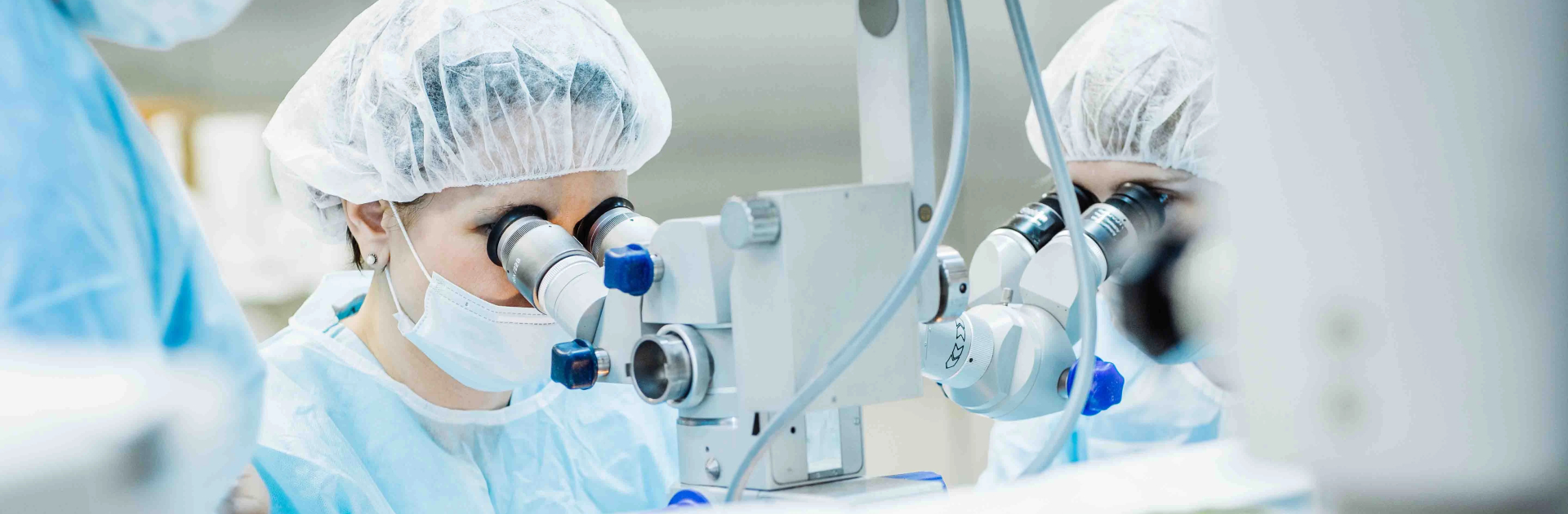
Excimer Laser Eye Surgeries

Excimer Laser Eye Surgeries

Femto-LASIK: A New Approach to Laser Vision Correction

The S.V. Malayan Ophthalmological Center has 13 years of experience in laser vision correction. Since 2002, over 6,000 laser procedures (PRK, LASIK) have been performed at the Center.

In 2010, Dr. Elena Malayan, Head of the Diagnostic and Laser Treatment Department, was the first in Armenia to perform LASIK vision correction. LASIK is a relatively new refractive surgery technique, known for its high effectiveness and favorable recovery. In March 2014, the Center introduced the advanced Femto-LASIK method, particularly beneficial for patients with thin corneas or complex refractive errors.

Thanks to Femto-LASIK, it also became possible to correct astigmatism in keratoconus patients using intrastromal corneal rings. This method retains all the advantages of traditional LASIK while offering major improvements. Unlike standard LASIK, Femto-LASIK uses a laser beam—not a mechanical blade—to create the corneal flap. The FS200 WaveLight femtosecond laser creates an ultra-thin flap within seconds, with precise control over thickness, diameter, and positioning.

Unlike other models, this laser allows highly accurate focusing at any corneal depth. It also requires the shortest flap creation time of any femtosecond laser on the market. The FS200 is integrated with the Center’s excimer laser, forming a unified system. Its sharp-angled flap edges promote faster healing and fewer complications.

The absence of mechanical impact is a key benefit, significantly reducing surgical risks and post-op complications.

Femto-LASIK Benefits:

High effectiveness with minimal side effects and fast recovery

Patient comfort during the procedure with no blackout or vision loss

Rapid visual recovery, with no incisions during flap creation

Correction for patients with thin corneas

Clear vision in low light conditions (twilight, night, rain, fog)

Surgeons at the Center follow global advancements and regularly adopt new treatments to help more patients achieve excellent vision. The Center continues to lead in treating myopia, hyperopia, and astigmatism with cutting-edge techniques.

Femto-LASIK is speed, reliability, precision — and the future of laser vision correction.

Dr. Elena Malayan shared insights about the newly introduced laser system in an interview:

Myopia, Hyperopia, and Astigmatism Treatment via LASIK

Initial full eye evaluations are completed in one day using the latest equipment from ALCON, operated by highly qualified specialists. This device is unique in Armenia and was manufactured in 2011.

In 2011, Dr. Elena Malayan performed Armenia’s first LASIK procedure with this system. Hundreds of patients have since been successfully treated, with up to 100% visual correction achieved.

LASIK is the most common procedure for myopia correction, but it’s also highly effective for astigmatism and hyperopia. As the most advanced vision correction method, LASIK combines microsurgery with excimer laser technology. It’s the most tissue-sparing and effective method, preserving the corneal layer structure. It has virtually no limitations for correcting all degrees of refractive errors and astigmatism.

Why is LASIK so popular?

Return to work and normal life the next day

Extremely short recovery time — vision often improves within hours

No damage to corneal surface layers

Local anesthesia via drops, well tolerated by patients

Painless post-op period

No corneal haze after surgery

High safety standards using next-generation laser equipment

Glaucoma Treatment

Glaucoma Treatment

Trabecular Micro-Implant “iStent” Now in Use at the S. Malayan Ophthalmological Center

The Glaucoma Department at the S. Malayan Ophthalmological Center has successfully introduced the iStent, a trabecular micro-implant developed by the American company Glaukos Corporation. This device offers a new, revolutionary method for slowing the progression of glaucoma. The iStent is the smallest device approved by the U.S. Food and Drug Administration (FDA), and its primary function is to lower intraocular pressure (IOP).

“People often assume that glaucoma is untreatable. But in reality, it only leads to blindness when ignored,” says Chief Ophthalmologist Aleksandr Malayan.

The iStent was invented by Dr. Richard Hill, a glaucoma specialist, professor at the University of California, Irvine, and board member of the Armenian EyeCare Project (AECP). He has visited Armenia many times and performed numerous surgeries.

The device is implanted by Associate Professor Lilit Voskanyan, Head of the Glaucoma Department at the S. Malayan Ophthalmological Center. With support from AECP, she trained under Dr. Hill in the United States and now applies her expertise in modern ophthalmic practice with great success.

Glaucoma is a disease in which fluctuations in intraocular pressure damage the optic nerve. Since the optic nerve is composed of nerve tissue, any damage to it is irreversible. Intraocular pressure is regulated by the outflow of intraocular fluid, and when this fluid cannot drain properly — often due to obstruction at the angle of the anterior chamber — it begins to compress the optic nerve. Shunts placed at this angle help improve fluid outflow and relieve pressure.

About 60% of patients at the Center are diagnosed with either primary or secondary congenital glaucoma, which eventually progresses and evolves over time.

Shunt implantation is an ideal procedure and typically causes no complications. Complications may only arise if the shunt alone is insufficient to reduce intraocular pressure.

Armenia — through the S. Malayan Ophthalmological Center — was among the first in the region to introduce this technology, marking a major achievement in the country’s healthcare system.

Professor Richard Lindstrom of the University of Minnesota’s Department of Ophthalmology, who visited Armenia with colleagues from the U.S. and Australia, praised the Center’s facilities and advanced surgical techniques. He also commended Dr. Voskanyan for her remarkable work, skill, and professionalism. He noted that the experience gained in Armenia can serve as a model for other medical fields as well.

According to Professor John Hovhannisyan of UCLA’s Jules Stein Eye Institute and AECP board member, the primary goal over the past two decades has been to bring the world’s top ophthalmologists to Armenia to help preserve vision for the Armenian people.

Today, international collaboration with leading specialists from around the world is especially important for Armenia. Hovhannisyan adds that it is a great honor to work with the highly skilled professionals at the S. Malayan Ophthalmological Center.

Cutting-Edge Glaucoma Treatment in Collaboration with Glaukos Corporation (USA)

From February 20–26, 2014, the S. V. Malayan Ophthalmological Center, in collaboration with Glaukos (USA) and leading glaucoma specialists from Germany, including Drs. Ohanova Y., Papoyan V., and Nersisyan L., carried out approximately 80 stent implantation surgeries for open-angle glaucoma under the supervision of Ph.D. Lilit Voskanyan, Head of the Glaucoma Department. These procedures used stents from different generations (G1, G2, G3) and are considered one of the most advanced treatments for glaucoma worldwide.

Armenia, through the S. V. Malayan Ophthalmological Center, remains the only country in the CIS where these surgeries have been successfully performed for over five years.

Since 2007, the Center has partnered with Glaukos Corporation, and in that time, over 2,000 patients have undergone surgery — without complications.

The surgery takes 3–5 minutes to perform. Glaukos (G-Series) stents are FDA-approved by the U.S. Food and Drug Administration.

Laboratory

Laboratory

Cataract Surgery via Phacoemulsification One of the essential conditions for clear vision is a transparent lens. Over time, the lens may become clouded due to various factors such as aging, intraocular inflammation, radiation exposure, eye trauma, and more a condition known as cataract. The main and most definitive treatment for cataract is surgical removal of the clouded lens and its replacement with an artificial intraocular lens (IOL). There are several surgical techniques for cataract removal, the most modern of which is phacoemulsification. Phacoemulsification is an ultrasound-assisted surgery involving a very small incision to remove the lens and implant an artificial intraocular lens. In Armenia, the first phacoemulsification procedure was performed by Professor Alexander Malayan in 1986 at the Republican Eye Center of the Ministry of Health (now the S.V. Malayan Ophthalmological Center). Today, it is considered one of the safest and fastest procedures — typically lasting 5 to 10 minutes — and is associated with minimal postoperative complications. Compared to older methods requiring large incisions, this technique has a key advantage: no stitches are needed, which eliminates suture-induced astigmatism and allows for full visual recovery as early as the next day. After surgery, patients typically use prescribed eye drops for 3–4 weeks and can return to an active lifestyle without restrictions. Over the past three years, the S.V. Malayan Ophthalmological Center has adopted the most advanced phacoemulsification equipment (Infiniti Alcon) and premium intraocular lenses. In the Pediatric Department, surgeries for congenital and acquired cataracts (lens opacification) are performed with excellent visual outcomes. Surgery can be performed from the age of 4 months, once the child can safely undergo general anesthesia. At this stage, cloudy lens material is removed without implantation of an intraocular lens. From age 1, lens removal is typically combined with simultaneous implantation of an artificial intraocular lens. The implanted lens does not need to be replaced throughout the patient life. Surgeries are performed using state-of-the-art equipment, including phacoemulsification and aspiration of lens masses. Mostly soft intraocular lenses are used; in some cases, a hard lens may be required. Lens selection is highly individualized and tailored to each eye. The surgical incision is very small, and the operation is completed without stitches. The goal is to preserve the transparency and optical clarity of the eye’s external structures. Cataract surgery is performed as early as possible to promote vision development in the affected eye, thus preventing a condition known as amblyopia (lazy eye).